Sorry, this entry is only available in Slovenčina.
(Slovenčina) Martina Chudá – Prespanka
(Slovenčina) Ivana Šáteková – Neznesiteľná ťažkosť bytia
(Slovenčina) BIELA KOCKA je doma! Na mieste oceneného projektu PRVÉ MÚZEUM INTERMÉDIÍ III. Nežná sila!
(Slovenčina) Jan Kostaa – Trofeje
(Slovenčina) Tomáš Rafa – “My body, my rules!”
Anton Čierny – With Kind Permission of My Father, 2014 – 2019
Anton Čierny – With Kind Permission of My Father, 2014 – 2019
During 1990’s, the intermedia nature of the work of Anton Čierny (1963) was defined by creating objects and installations made with emphasis on their site-specific nature. Approximately since the turn of the millennium, this intermedia framework substantially “dematerialised”, and the “site-specific” was redefined as “context-sensitive”. The main medium of the artist’s expression became personally carried out private or public performances recorded on video and participative pieces. His interest in locations as spaces where one is anchored (in social, geographical, cultural, political context) and his interaction with the locations became more evident. The artist’s performances specifically made for video recording are mainly classified by exploring location that is selected based on specifics, but perceived by the artist as a complex unit. Concentrating on the memory of a specific place also became key, and it unfolds through the exploration of the space in often adventurous manners (like sailing an amateur-made vessel or balloon flight). This activity enables the artist to comment on the status of his subject, but most of all, to underline the difference between the so-called general (official) history of the given place, and its memory mediated by an individual’s point of view, whose subjective memory and his voice are almost always threatened by extinction in the passing of time.
The work With Kind Permission of My Father (2014 – 2019) communicates the nuances of the artist’s personal (family) bond with the location of the village Laskár in the region of Horná Nitra. By concentrating on the wider contexts of this location – historical, but also those contexts that create its current appearance, he defines his identification with this place. This performance for video originates in a lineage of works where the artist progressed from mapping of private space and exploring his own identity and its factors, to works that refer to wider contexts – his own connection (as a native, national, state resident) to the places of genius loci with history connected to manifestations of nationalism, antisemitism, or negative impacts of totalitarian regimes.
With Kind Permission of My Father is a variation on formulating a relationship to a specific location: an emphasis on the hard to grasp factor of fellowship or showing the reality that an individual with personal ties to a location often only has minimal possibilities to influence the development and changing face of that place. This is represented by the models of individual and collective features of pieces that the artist carefully selects depending on the content and context.
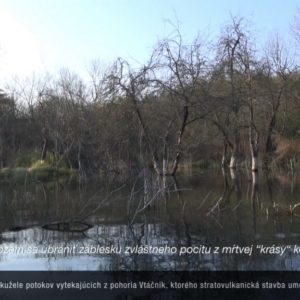
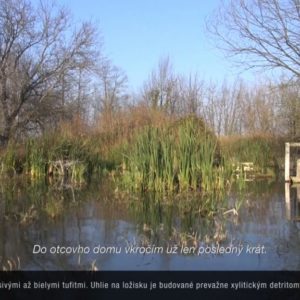
“This video is a reflection of a submerged village Laskár near Nováky that became the victim of mining industry in this region of Slovakia. First, an evacuation of inhabitants took place, then its demolition, an finally, it became one of many ground drops of this area flooded with water. I pass places that I used to visit (father’s birth place and my grandmother’s house) on a vessel that I constructed. I am looking for the house, the garden and a park, where I used to play. This piece isn’t only about a lost place or identity, but also about strategic and economic interests of the state – hidden politics of power leaving devastated environment behind.” This is the citation of the artist’s statement about this work.
Exhibition is supported using public funding by Slovak Arts Council.







Peter Rónai – autoReverse, 1997
Peter Rónai – autoReverse, 1997
The long-term agenda of artist Peter Rónai (1953) is the thematisation of the world of art through a strong subjectve lens – aimed at the art’s condition and its perception at the time of maturing postmodern age – especially the revision of ideas of the avant-garde resonating in the present times. The thematisation of the world of art offered by P. Rónai is defined by an example of two interconnected aspects. One of them is his permanent self-ontextualisation – defining his own position in art (as an art creator, author), but also making of an antithesis to art – forms of communication/dialogue with art throughout its history (not only 20th century, but also earlier periods). The second aspect is his personal/existential “self-presentation” through portrayal of his own face, mainly via the application of self-portrait photography. In the artist’s understanding, the function of this photography is naturally ambivalent: it underlines the cult of the artist, but also challenges it (through manipulation of the face), and therefore it is also iconoclastic.
The works KUNSinvHALLE (1972 – 2014) and autoReverse (1997) can be perceived as an illustration of the mentioned interconnected aspects: KUNSTinHALLE actually demonstrates a system of the artist’s self-contextualisation, therefore it works as his entrance to the history of art. He uses tools of citation, interpretation, but also formulation of antitheses, but – in the spirit of the avant-garde – representing a portrayal of the fusion of life (private and artistic existence) and art. autoReverse is a portrait – self-preservation and self-presentation, but also an example of self-reevaluation, or even self-irony by using metamorphosis/manipulation of his portrait or commenting on his own position as an artist.
In relation to the subject of the display First Museum of Intermedia: Memory and Information, pieces are presented as specific variations of the mentioned themes. autoReverse reflects the activity that is own to all of us – creating traces of memory capturing the flow of our existence, such as photographs documenting individual stages of our lives. This video is a time-lapse version of the portrait of the artist – it captures the transformations of his portrait from childhood to his likeness at the time of the completion of this work (1997). It takes form of a condensed personal photo album. He used the technique of morphing, enabling him to create smooth fade-over of one image to another in order to transform the photographs. At the time of making this work, the tools for morphing (PC technology and software) were quite inaccessible, and whatever is possible to achieve with any graphic software today, had to be made via a more complicated system – individually, photo by photo. The technique of morphing is an important attribute of Peter Rónai’s work – treatment and manipulation of photography is essentially synchronous with thinking about one’s own identity and identity generally in several artists’ works and especially those working with the new media during the 1990’s. Morphing, one of the strategies of creating post-photography (hybrid medium using elements of analogue and digital image and practices of media art) can define photography as an attribute/representative of identity freed from the traditional understanding of the flow of time, intervening in formatting and mechanisms of our memory. The video composed of 44 portraits overlapping one another was originally part of an installation with same title shown by the artist at the Videoanthology exhibition at Museum of Art Žilina. This video piece was part of a typical medium of the second half of the 1990’s – video installation created using the principles of the readymade. This was a supermarket shopping trolley filled with goods connected to a field bottle via cable. Rónai modified this bottle for watching his self-portrait video on a small screen. The flow of time (present in his morphing portraits) or what we experience and lose, created a content opposition to what we gain and (do not need) paraphrased by the shopping in the trolley.
Exhibition is supported using public funding by Slovak Arts Council.


Juraj Bartusz – Catch me, Catch me! I am Searching for the Face of Classmate Sára Rosenblum in My Memory, 1995
Juraj Bartusz – Catch me, Catch me! I am Searching for the Face of Classmate Sára Rosenblum in My Memory, 1995
Installations Marchieren Marsch! (1993) and Catch me, Catch me! I am Searching for the Face of Classmate Sára Rosenblum in My Memory (1995) were created by the artist during the 1990’s, when the expansion of the spatial media, mainly installation, characteristically prevailed. At that time, Juraj Bartusz (*1933) also produced several installations that represent the confirmation of the dominance of this medium, but also, in relation to their specific accidence and theme, they are unique models of installation. Their prototype form is anchored in Bartusz’s action art from 1970’s and 1980’s. Alongside the principle that defines the relationship between action and installation (installation is considered to be a form of concentrated action), the gesture of the artist is a very important identifier of these installations. Not as a form-making element of the work (means of its creation) present in other areas of his work but in the installations of Juraj Bartusz, gesture is rather a carrier of meaning. It is an expression of the artist in form of an ironic or critical commentary, or it is a manifestation of resistance. In this notion, the artist’s gesture was also typical for action pieces in which he demasked and ironised nonsensical bureaucratic processes and mechanisms of the control of an individual’s privacy in a socialist society, or used them to express civil and human attitudes to social and later also ecological themes. Along with these, with their system of construction through selection of components and their provenance, the other installations from the first half of the 1990’s such as Back to Europe (1991) or Homeland (1992) declare an affinity to Arte Povera – the artist constructs the installations from found materials, he uses natural resources (textile, leather, wood, stone, lining paper, wheat) and components that are tied more closely to the private life of an individual (suitcase, clothing). The installations of this artist also dispose of postmodern narration: they connect the articulation of important contemporary subjects of and individual’s and social existence with references to past experiences. Through this, they create a certain antidote (in meaning and composition) to the later installations produced by the generation of artists of 1990’s (R. Ondák, B. Ondreička, D. Lehocká, P. Nováková-Ondreičková) with a more ‘unmoved’ neo-conceptual code.
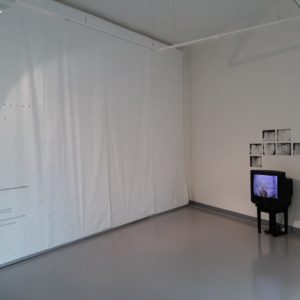
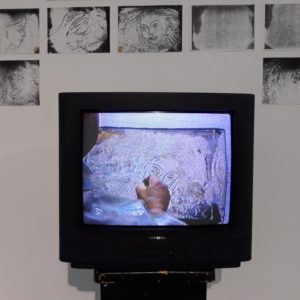
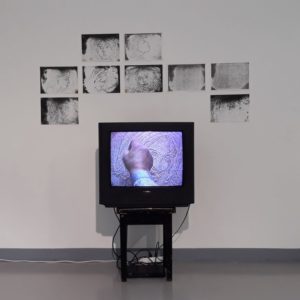
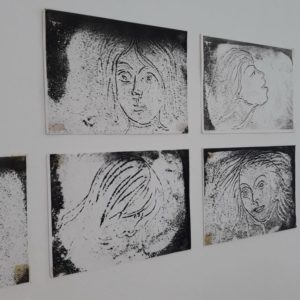
The artist created the installation Catch Me, Catch Me! I am Searching for the Face of Classmate Sára Rosenblum in My Memory (1995) for the exhibition Dream of a Museum? (1995) at the Museum of Art in Žilina. It was preceded by a private performance of the artist, where he would draw the face of his childhood classmate Sára on a flour poured on a baking sheet from his memory, then shake the sheet in order to erase her face and start repeatedly drawing again, while the drawing process was recorded on a video that later became part of the video installation along with the baking sheets with drawings in flour. In the same year, he presented a performance with the same name at Palmovka Synagogue in Prague. This work therefore connects an action art outcome with tangible artefact – medium of sculpture. At the beginning of the 1990’s, the system of composing – integration of performance recording/video with the body of an installation was typical for other artists as well (for example J. Želibská, M.Nitz). Along with the installation Marschieren Marsch! (1993), these pieces are unique contributions to intermedia (installation) art of the 1990’s that reflect the problematics of historical and collective memory, but most of all, they draw attention to the threat of its failure and the consequences. Both works carry a strong personal thread of the artist’s experience of the Second World War. He created the installation Marschiern Marsch! from munition boxes that he found in the gallery loft. The morphology of this work refers to a specific experience: the front line crossed Kamenín in Southern Slovakia, the village where he comes from. The cumulation of boxes/suitcases, clothing and the presence of authentic post-explosion Katyuschas (found on the yard after the war) in the installation is an image of how devastatingly the war affected the country, but most of all lives of the many people that were forced to leave their homes. The video installation Catch me, Catch me! I am Searching for the Face of Classmate Sára Rosenblum in My Memory portrays the growing impossibility/inability to recollect (and remember!) this worldwide trauma. It is a visual metaphor of forgetting portrayed in continual attempts to remember/draw the face of his Jewish classmate Sára, a playful little girl that did not come to school one day, and the artist never saw her again. Both works correspond with the concept of the current display PM II dedicated to memory – a phenomenon that strongly resonates in contemporary art. It also makes one of the paradoxes of current society present: being concerned with the past namely reflects fears of the future. This aspect of contemporary art was also prerecorded in many ways by installations of Juraj Bartusz created during the 1990’s.
Exhibition is supported using public funding by Slovak Arts Council.